
Let me start with a number that should stop anyone pursuing a tech certification in their tracks.
Roughly 35 to 45 percent.
That’s the estimated pass rate for people who attempt tech certifications through self-study alone. CompTIA A+. Network+. Security+. Cisco CCNA. AWS Solutions Architect Associate. Microsoft Azure. The number is remarkably consistent across every major certification body when you strip away the structured programs.
Compare that to the 81 percent pass rate my students hit through structured programs. Or the industry-wide average across all study methods, which sits around 60 to 70 percent.
The gap between studying alone and studying with structure is not small. It’s the difference between a coin flip and a near guarantee.
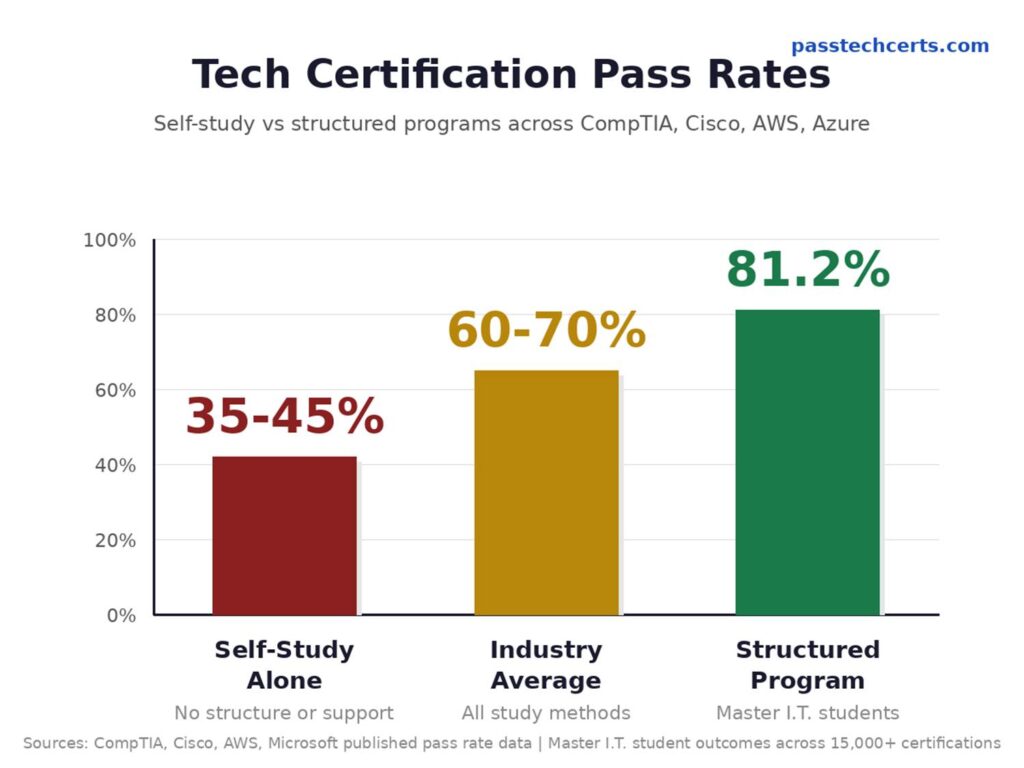
Pass rate comparison across three study methods for CompTIA, Cisco, AWS, and Azure certifications combined
And it’s the reason self-study is the most expensive path to any tech certification, even though it looks like the cheapest one.
Self-studying for tech certifications isn’t a discount. It’s a hidden cost that most people don’t calculate until it’s already been paid.
I’ve been in the IT industry for 20 plus years. Army veteran. Twelve plus CompTIA certifications. Founded a company that has certified over 15,000 students across A+, Network+, Security+, CySA+, PenTest+, and beyond. I’ve watched people succeed and I’ve watched people fail, and the single most reliable predictor of which group someone ends up in is whether they studied alone or studied with structure.
Let me show you the math.
The Real Cost Of Studying Alone
When someone tells me they’re going to self-study a tech cert to save money, I always ask them one question.
Have you actually calculated what it costs when it doesn’t work?
Almost nobody has. So let me walk you through the numbers.
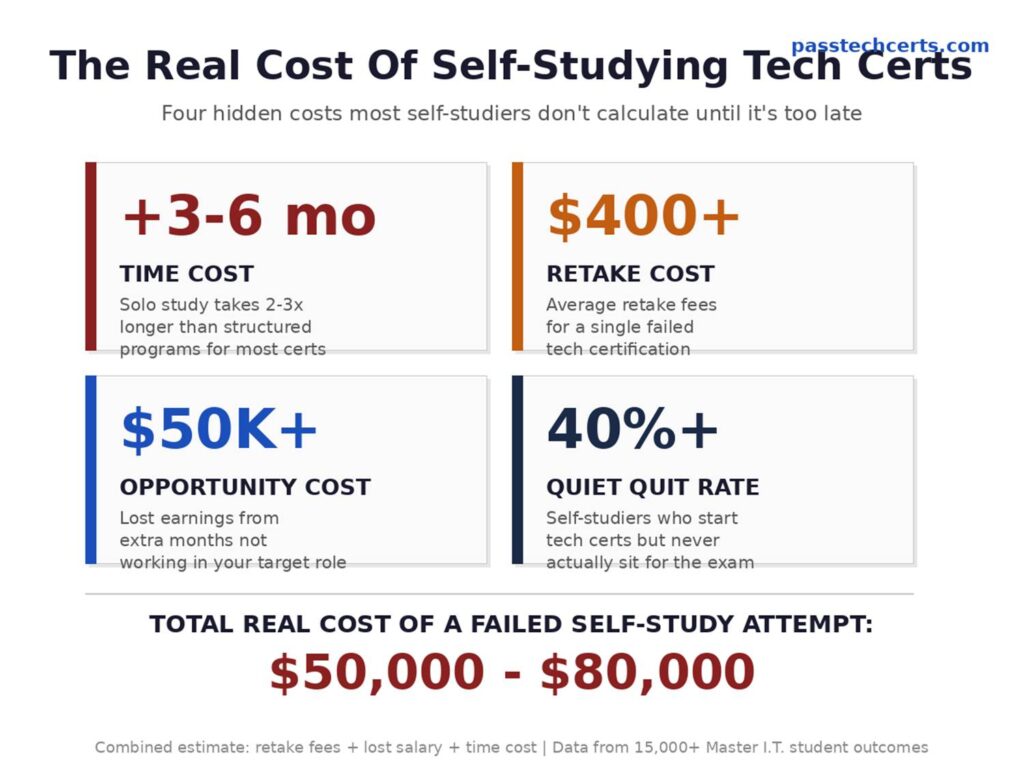
The four hidden costs of self-studying tech certifications (based on 20+ years of student data at Master I.T.)
The Time Cost:
Self-studiers typically take 2 to 3 times longer to prepare for a tech cert than students in structured programs. That’s an extra 3 to 6 months of your life spent staring at material that could have been organized for you from day one.
The Retake Cost:
Retake voucher costs vary by certification. CompTIA A+ costs $246 per retake. Cisco CCNA is $300. AWS Solutions Architect Associate is $150. Microsoft Azure exams average $165. Multiply by the number of attempts most self-studiers need, and the retake costs alone often exceed the cost of a structured program.
The Opportunity Cost:
Every month you’re studying is a month you’re not working in your target role. Entry-level IT support: $68,540 median (Glassdoor 2026). Network engineer: $110,000-$155,000 (Robert Half 2026). Cybersecurity analyst: $112,000 median. Stretch your certification timeline from 12 weeks to 12 months and you’ve lost $50,000 or more in earning potential you’ll never get back.
The Quiet Quit Cost:
Here’s the one nobody talks about. An estimated 40 percent or more of people who start studying for a tech cert never actually sit for the exam. They stall out, lose momentum, and quietly stop. All the time, money, and mental energy they invested becomes sunk cost.
Add all four together and the real cost of a failed self-study attempt often runs $50,000 to $80,000 in combined direct expenses and lost earning potential.
The structured program most self-studiers avoid to “save money” costs a fraction of that. And it dramatically increases the odds of actually finishing.
Not sure which tech cert is right for you?
Take the free IT Career Roadmap Quiz. Five minutes. Tells you which certification path fits your specific situation, background, and goals.
What Actually Happens When You Study Alone
I’ve watched this play out hundreds of times over 20 years in this industry. The pattern is so consistent it’s almost predictable. It doesn’t matter which certification we’re talking about. Whether it’s an entry-level A+ or an advanced Security+ or a cloud cert like AWS Solutions Architect, the failure sequence looks the same.
Here’s exactly what happens, step by step, when someone attempts a tech cert through self-study alone.
1. They buy a 1,200-page book and download a stack of PDFs. They watch 40 YouTube videos in the first week. They feel productive because they’re consuming content, but they have no framework for measuring whether they’re actually learning it or just recognizing it.
2. By week 3, they hit their first real plateau. Sometimes it’s subnetting. Sometimes it’s IAM policies. Sometimes it’s group policy objects, VLAN trunking, or the OSI model. Whatever their specific plateau is, they have no coach to help them break through it. They either skip it (dangerous) or spend three days trying to figure it out alone (exhausting).
3. By week 5, they start taking practice exams. Their scores are lower than they expected. They don’t understand which knowledge gaps are causing the wrong answers, so the practice exams stop feeling like learning tools and start feeling like confidence killers. Some quit here.
4. By week 8, they’ve lost momentum. Life happens. Work gets busy. Family stuff comes up. Nobody notices when they miss a study session. Nobody follows up when they miss a week. There’s no accountability structure catching them when they fall off. Most self-studiers who quit, quit somewhere in this window.
5. The ones who push through sit for the exam. Many fail by 30 to 50 points because their self-designed study plan missed critical exam objectives they didn’t even know existed. They pay for a retake voucher. Some retry successfully. Many don’t retry at all.
This is not a hypothetical. This is what happens with statistical consistency to people who try to certify without structure or support. And it’s the same failure pattern whether we’re talking about CompTIA, Cisco, AWS, Microsoft, or any other major certification body.
Why Structured Programs Work
The people who pass tech certifications with a structured program don’t have some genetic advantage over self-studiers. They have a system that solves for the exact failure modes I just described.
Here’s what actually changes when you study inside a structured program:
→ The study path is designed for you. You know exactly what to study each day, in what order, for how long. No decision fatigue. No wondering if you’re ahead of schedule or behind.
→ Practice exams are calibrated to the real exam difficulty. Your practice scores actually predict your real exam outcome, so you know when you’re ready and when you’re not.
→ When you hit a wall on subnetting, IAM policies, VLAN configuration, or any other concept, you have coaching to help you break through in hours instead of days. Nobody in a good program stays stuck for a week.
→ Cohort accountability means when you fall off for a week, someone notices. Someone reaches out. Someone pulls you back in before you’re gone for good.
→ Exam timing systems train you to move through the exam under pressure. Most self-studiers fail their first attempt not because they don’t know the material, but because they run out of time on the last 15 questions and guess.
→ Community context means you’re learning from other people’s mistakes and questions, not just your own. You get exposure to concepts you didn’t know you needed to know.
None of these things are magic. They’re just systematic solutions to the specific failure modes that kill 55 to 65 percent of self-study attempts.
And here’s the reality that most people trying to save money on certification prep miss:
The cheapest path to certification is the one that works on the first attempt. Every other path is more expensive.
Any structured program that produces a pass rate 30 to 40 percentage points higher than self-study is essentially paying you back the cost of enrollment in avoided retake fees, avoided lost time, and accelerated earning potential.
Ready to skip the mistakes most tech cert candidates make?
The certification programs at Master I.T. are built specifically to solve for the failure modes described above. Structured paths, calibrated practice exams, direct coaching, cohort accountability, and pay-if-you-fail guarantees across A+, Network+, Security+, and beyond.
→ See The Full Certification Programs
This Applies To Every High-Stakes Tech Certification
The math I just walked you through is universal across the tech certification industry.
CompTIA Track:
A+, Network+, Security+, CySA+, PenTest+, and beyond. Every one of these has a self-study pass rate that’s significantly lower than the structured-program pass rate. And every one of them builds on the previous credential, which means skipping the foundation to save money on structured prep just creates a knowledge gap that catches up with you on the next exam.
Cisco Track:
CCNA is one of the most widely respected networking credentials in the industry, and one of the most difficult to self-study for effectively. The Cisco material is dense, the exam is unforgiving, and the concepts require hands-on lab work that most self-studiers never actually complete. Self-study pass rates for CCNA are among the lowest of any tech cert.
Cloud Track (AWS, Azure, Google Cloud):
AWS Solutions Architect Associate. Microsoft Azure Administrator. Google Cloud Professional. These credentials look easier to self-study because the material is well-documented online. In reality, they have some of the highest failure rates for solo studiers because the exam questions test scenario-based understanding that comes from actual project experience, not memorization.
The pattern doesn’t change because the failure modes don’t change.
Human beings need structure, feedback, accountability, and community to reliably learn complex technical material. Self-study fights against every one of those needs.
This is not an argument against learning independently. It’s an argument against learning WITHOUT structure when the stakes are your career, your money, and your time.
If you’re studying just for curiosity, self-study is fine. If you’re studying to change your entire trajectory in life, you owe it to yourself to use the method that actually works at the highest rate.
The people who make it in this industry aren’t the smartest people.
They’re the people who set themselves up to win from day one.
Your Turn
I want to open this up to the professionals reading this.
If you’ve certified in any tech certification, whether it’s CompTIA, Cisco, AWS, Azure, or something else, I want to hear from you in the comments.
What actually made the difference for you? Did you self-study or use a structured program? What was your single biggest study challenge? What would you tell someone considering their first tech cert in 2026?
Your comments will help hundreds of people reading this who are on the fence about which path to take. Share below.
Want a 1-on-1 conversation about your specific path?
If you’re still not sure which certification is right for you, or you want to talk through your situation with someone who’s helped 15,000+ students walk this path, book time on my calendar below.
If this article resonated with you, share it with one person in your network who’s been thinking about a tech certification but hasn’t made the move.
The 35 to 45 percent self-study fail rate is only a statistic until it’s your friend, your sibling, or your coworker who quietly gave up on their tech career because nobody warned them what studying alone actually costs.
— Rob Roberts
Founder, Master I.T. | Army Veteran | 20+ Years in IT | 12+ CompTIA Certifications